

Is a rate buydown better than a price reduction when buying in Boise?In most cases, yes. When sellers in Boise are negotiating, buyers who ask for a seller-paid rate buydown instead of a price
What are Idaho sellers required to disclose when selling a home?
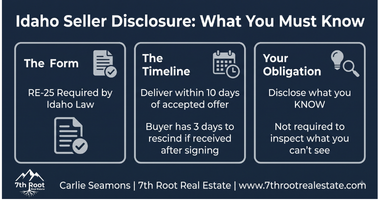
Idaho law requires sellers of residential property to complete the Seller's Property Condition Disclosure form (RE-25) and deliver it to the buyer within 10 calendar days of accepting an offer. You are required to disclose known material defects, meaning conditions you are actually aware of that could affect the value or desirability of the property. You are not required to conduct inspections to discover defects you don't already know about. Failing to disclose a known defect can expose you to liability for actual damages and, in some cases, a fraud claim.
By Carlie Seamons | July 31, 2026
One of the questions I hear most from sellers getting ready to list is some version of: "What do I have to tell the buyer?"
It's the right question to ask before you go to market. Idaho has specific legal requirements around seller disclosures, and understanding them protects you both during the transaction and after closing.
Here's how the Idaho Seller's Property Condition Disclosure works, what it covers, and what sellers in the Treasure Valley need to know.
The Form: RE-25
Idaho uses a standardized form called the Seller's Property Condition Disclosure, also known as the RE-25. It's required by state law for residential property sales, which includes single-family homes, properties with up to four dwelling units, and individually owned units in larger structures.
The form covers a wide range of property conditions across multiple categories. Sellers answer questions about:
- The structure: roof, foundation, walls, windows, doors
- Water: well, septic, plumbing, drainage, flooding history
- Mechanical systems: HVAC, electrical, appliances
- Environmental concerns: lead paint, mold, asbestos, radon, underground storage tanks
- Legal and title issues: easements, encroachments, zoning violations, HOA matters
- Neighborhood conditions: known disputes, noise, nuisances
For each item, you indicate whether you are aware of any issues. If you are, you describe them. If you're not aware, you say so.
What You Must Disclose: Known Material Defects
Idaho's standard is clear: you must disclose conditions you actually know about that are material, meaning they could affect the value or desirability of the property and would not be obvious to a reasonable buyer on a casual walkthrough.
That means past water intrusion you fixed five years ago. It means the HVAC system that's been running but has needed repeated repairs. It means the neighbor dispute over the fence line. It means the roof that was patched but never fully replaced.
It does not mean you need to disclose every minor cosmetic issue, normal wear and tear, or trivial imperfection. A scuff on a baseboard or a sticky drawer handle is not a material defect.
What You Don't Have to Disclose
Idaho does not require sellers to conduct inspections of areas that are generally inaccessible, such as inside walls, below the foundation slab, or beneath the roof decking. You disclose what you know. You are not expected to go find things you don't know.
This is an important distinction. Sellers sometimes worry they'll be held responsible for defects a home inspector finds after closing that they genuinely weren't aware of. Idaho law is clear that liability attaches to willful or negligent failure to disclose, not to unknown conditions.
That said, the line between "I didn't know" and "I should have known" can be contested. If there is visible water staining on a ceiling and you claim you didn't know about moisture issues, that's a harder position to defend.
The Timeline
The RE-25 must be delivered to the buyer within 10 calendar days of the seller accepting the offer.
If the disclosure was not provided before the contract was signed, the buyer has 3 business days after receiving it to rescind the offer. This is a meaningful window. It means a buyer who receives the disclosure and sees something unexpected has a legal right to walk away without penalty.
This is one reason I recommend having the disclosure form completed before you go to market, not after you accept an offer. It removes uncertainty, speeds up the transaction, and gives buyers full information when they're making their decision.
Selling "As-Is" Does Not Eliminate Your Obligations
This comes up often. Sellers sometimes believe that listing a property as-is relieves them of disclosure requirements.
It does not.
An as-is sale means the buyer agrees to accept the property in its current condition without requiring the seller to make repairs. It does not mean the seller can withhold known information about what that condition is. You still have to complete the RE-25. You still have to disclose known material defects. The buyer's decision to proceed as-is is an informed one, not a blank check.
Who Is Exempt
Certain transactions are exempt from the standard disclosure requirement, including probate sales, foreclosures, court-ordered transfers, and transfers between close family members.
But here's what matters even in exempt transactions: sellers always retain a duty to disclose material defects they are aware of, regardless of the exemption. The form may not be required, but the underlying obligation to avoid concealment does not go away.
What's at Stake If You Get It Wrong
Idaho law is direct on this. A seller who willfully or negligently fails to disclose a known defect is liable for actual damages suffered by the buyer. In cases where the nondisclosure appears intentional, it can rise to a fraud claim.
Post-closing disputes over disclosure are one of the most common sources of real estate litigation. They're also largely avoidable when the disclosure is handled carefully and honestly at the time of listing.
Your listing agent should review the disclosure form with you before you complete it, not after. The goal is accuracy, not minimization.
How This Fits Into Your Listing Preparation
Completing the RE-25 is one of the first things I work through with sellers before we set a list price or schedule photos. Why? Because what you disclose can affect how we price the property, how we market it, and how we respond to inspection findings after an offer comes in.
A seller who knows their roof has 5 to 7 years left on it prices and positions the home differently than a seller who hasn't thought about it yet. Getting ahead of that conversation is part of protecting your net.
If you're thinking about listing and want to understand what the disclosure process looks like for your specific home, I'm happy to walk through it with you. And if you haven't yet looked at your full seller costs, that's worth doing before you list: How Much Will You Net Selling Your Home in Boise, Idaho?
Reach out anytime at www.7throotrealestate.com.
Frequently Asked Questions
What is the Idaho Seller's Property Condition Disclosure form?
The Idaho Seller's Property Condition Disclosure, also called the RE-25, is a state-required form that residential sellers must complete and provide to buyers. It covers the condition of the structure, systems, water and septic, environmental concerns, and legal matters affecting the property. Sellers must deliver a completed, signed copy within 10 calendar days of accepting a buyer's offer.
Do Idaho sellers have to disclose defects they didn't know about?
No. Idaho law requires sellers to disclose known material defects, meaning conditions they are actually aware of. You are not required to conduct inspections to discover unknown defects. However, willfully or negligently failing to disclose a known problem can result in liability for the buyer's actual damages.
Can a buyer back out after receiving the seller's disclosure in Idaho?
Yes. If the disclosure was not provided before the purchase contract was signed, Idaho law gives the buyer 3 business days after receiving it to rescind the offer. This is one reason to have the disclosure form completed before you list, so buyers have full information when they make their offer.
Does selling a home as-is in Idaho eliminate the disclosure requirement?
No. An as-is sale means the buyer accepts the property without requiring repairs. It does not exempt the seller from completing the disclosure form or from disclosing known material defects. The buyer's decision to proceed as-is is based on knowing what the condition is, not on agreeing to proceed blind.
What happens if a seller fails to disclose a known defect in Idaho?
A seller who willfully or negligently fails to disclose a known material defect can be held liable for the buyer's actual damages. In cases where the nondisclosure appears intentional, it can be treated as fraud under Idaho law. Post-closing disclosure disputes are one of the most common sources of real estate litigation and are largely avoidable with careful, honest disclosure upfront.
About Carlie Seamons
Carlie Seamons is an Associate Broker with Boise Premier Real Estate and a seventh-generation Idahoan serving buyers and sellers across the Treasure Valley. She holds NAR's Pricing Strategy Advisor (PSA) designation and specializes in helping first-time homebuyers, upsizers, and downsizers navigate the market with confidence. Connect with Carlie at www.7throotrealestate.com.
 Information provided by Intermountain MLS (IMLS) is deemed reliable but not guaranteed.
The data relating to real estate for sale on this website comes in part from the Internet Data Exchange program of the Intermountain MLS system. Real estate listings held by brokerage firms other than Boise Premier Real Estate are marked with the IDX icon.
IDX information is provided exclusively for consumer's personal, non-commercial use, that it may not be used for any purpose other than to identify prospective
Information provided by Intermountain MLS (IMLS) is deemed reliable but not guaranteed.
The data relating to real estate for sale on this website comes in part from the Internet Data Exchange program of the Intermountain MLS system. Real estate listings held by brokerage firms other than Boise Premier Real Estate are marked with the IDX icon.
IDX information is provided exclusively for consumer's personal, non-commercial use, that it may not be used for any purpose other than to identify prospective
 The data relating to real estate for sale on this web site comes in part from the IDX Program of the Snake River Regional Multiple Listing Service © 2026.
Information provided is deemed reliable but not guaranteed. All properties are subject to prior sale, change or withdrawal. The information being provided is for consumers personal, non-commercial use and may not be used for any purpose other than to identify prospective properties consumers may be interested in purchasing.
This content
The data relating to real estate for sale on this web site comes in part from the IDX Program of the Snake River Regional Multiple Listing Service © 2026.
Information provided is deemed reliable but not guaranteed. All properties are subject to prior sale, change or withdrawal. The information being provided is for consumers personal, non-commercial use and may not be used for any purpose other than to identify prospective properties consumers may be interested in purchasing.
This content
